
Hello and welcome back to another blog post by, The Eason Clan. I am excited about today’s post, mainly because it’s about a truly remarkable story that often gets overlooked by popular themes and stories in the Bible. Today you will read about Jonathan, the son of the Israelite King Saul. Jonathan is quite special in many ways: he was the first prince of Israel, he became best friends with David (who would later become king over Israel), and he was a true patriot and devoted Israelite. There are some life lessons that we can learn from Jonathan, and I will be focusing on one event in particular – Jonathan’s daring raid at Michmash.
If you enjoy heroic battles, biblical insights, and learning about cool things in general, then I encourage you to read till the end. Enjoy!
Before we begin, I am going to lay some groundwork. Unlike every other book in the world, the Bible is said to be alive. Yes indeed, many Christian leaders refer to the Bible as living and active. How can it be that a book, something that is concrete (physical) also be abstract at the same time? That may seem strange and wacky, but if you read the scriptures in the Bible, it actually makes sense.
In multiple places in the Bible, it states that the Word of God (Bible), is in fact, alive. In Hebrews 4:12 it says, “For the word of God is alive and powerful.” We find in 2 Timothy 3:16 , “All scripture is inspired by God and is useful to teach us what is true and to make us realize what is wrong in our lives.” The Holy Spirit inspired the writers of the Bible, hence why all the prophecies, book organization, and unity within all the books -even though they span over thousands of years and has dozens of writers- form one giant, cohesive story.
What am I saying here? As someone who has studied the biblical books of 1 & 2 Samuel for over twenty years, I am still amazed at how I keep learning new concepts, yet I’ve read the same passage, over and over, dozens of times. I believe it’s Holy Spirit inspired; that’s why I can keep learning, because my life is always changing, yet the Bible stays consistent. Therefore, each time I go through a different stage of life, the scriptures can speak to me in different ways. So cool, right?
Let’s go!

Have you ever rock climbed before? I remember my first terrible attempt at a place called Wallnuts, located in St. John’s, NL. Let’s get two things straight: first, I’m not the best at heights; second, I didn’t even want to be there in the first place.
“Why go then?” you might ask. Well, the short version is that I used to deliver newspapers, and because I delivered newspapers with skill, I won a newspaper delivery competition. My prize for winning: an mp3 player (for those that know what that is, I salute you) and a free admission to the rock climbing place, where the newspaper company was hosting the party – where my mp3 was being held.
Essentially, if I wanted the mp3 player and I had to go climb walls, eat some pizza and get my reward. What could go wrong?
Once I was hooked up with the harnesses, I grabbed ahold of my rope and made my way up the wall. After thirty long minutes of embarrassing attempts at wall crawling (like a drunk Spider-Man with a blindfold) my name was called, and I went to the front of the award line with a horrible wedgie (thank you harness), sore knuckles, and shaking legs – what a great combo for accepting an award. Thank God, I received my mp3 player, and left that place with the resolve to never return!
Jonathan, obviously, never had an issue with rock crawling, considering that he climbed this.
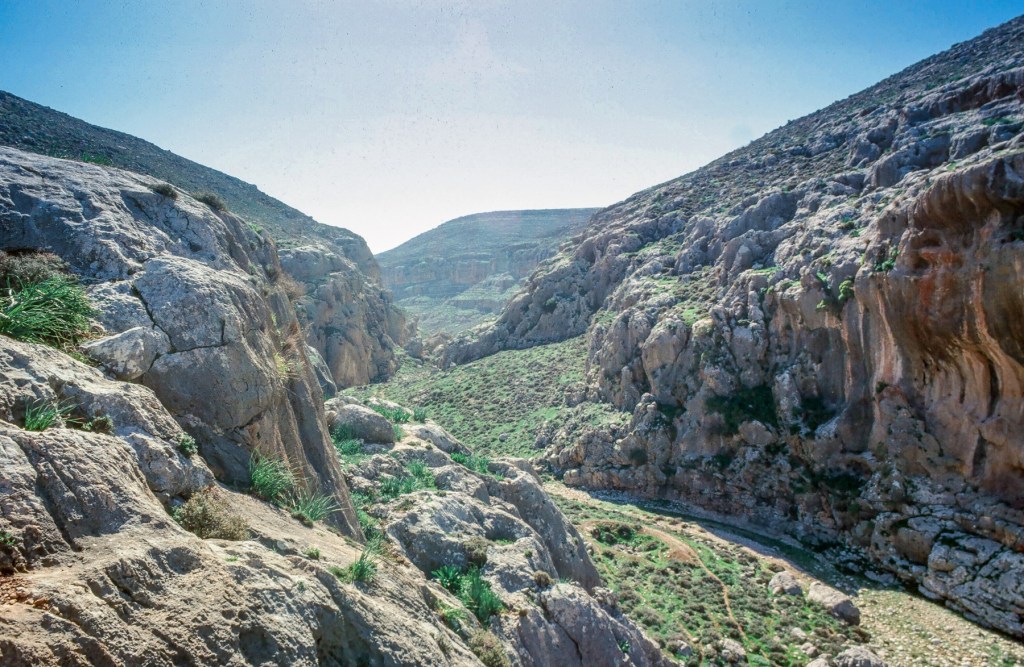
This area of rocky terrain is in Israel, and is known as the Pass of Michmash, located about six miles north of Jerusalem. One side of the passage is called Bozez and the other is Senah. Known for its jagged rocks, steep cliffs, and narrow caverns, it’s a brutal spot for any soldier to try and fight in – especially if your enemy has the high ground, meaning the higher elevation. In the case of our story, the Philistines had the high ground.
In the Bible, the Philistines are described as an advanced military society with unknown origins. Most scholars believe that they came from the West, possibly from Cyprus or further, as they seemed more Greek influenced and worshipped the false god, Dagon ( a sea god); they were very different from the Middle Eastern cultures of the time. The Philistines had unique armour (bronze coats of mail, feather-plumed metal helmets, spears with bronze tips, bronze swords, and bronze leg armour). No one in the area of Israel, in this time period, had any kind of armour or weapons like these guys. They also had iron chariots, which Israel did not – which was a game changer for these groups of people, much like our modern day army tank.
In fact, all throughout the books of 1 and 2 Samuel, the Philistines were always seen as the more advanced fighter group. When the Israelites won, mainly it was because of, 1) God was fighting for them (natural disasters, earthquakes, hail, etc); 2) Israel had some pretty intelligent leaders and excellent warriors – who often use guerrilla-type warfare to win their battles (not open ground, full on fighting), and 3) Israel later became more established as a nation and started focusing on warfare and eliminating their long-time foes.

Now that we have more context, let’s get to the ‘meat and potatoes’ part of this story. In 1 Samuel 14, the prophet Samuel (or possible Nathan) writes that the Philistines had military outposts throughout the land of Israel, and that King Saul and his 600 men (remember, a much smaller fighting force and poorly armed) were at Gibeah, which is not far from Michmash. Jonathan and his armour bearer had left the main camp of the Israelites, and secretly went to where the Philistine outpost was located. He purposely did not tell his father, King Saul, that he had left.
I find this interesting, because it offers to us some insight into Jonathan’s thinking. King Saul was the very first king of Israel, and his origin story is pretty rocky at times – cowering behind luggage when the people tried to make him king; freaking out when one of the enemy nations of Israel attacked a town, and under pressure, Saul threatened to kill the oxen of any man who did not help him fight against them…you know, the normal kind of sketchy stuff. In the middle and latter chapters of 1 Samuel, Saul becomes increasingly unstable, paranoid, and eventually tries to kill Jonathan and David (spoiler alert!) So it’s very possible that Jonathan did not tell his father where he was going, for this very reason that his dad would have said, no.
I could hear Saul now, “No, son. The two of you will not try and fight the entire Philistine outpost by yourselves, I forbid it.”
Ehhhhh, that is actually some sound advice.
That was not, however, Jonathan’s mindset. Jonathan wasn’t depending on his own fighting skills and abilities to help him win, he was looking to God for help and guidance. Have a look yourself, “Let’s go across to the outpost of those pagans,” Jonathan said to his armour bearer. “Perhaps the Lord will help us, for nothing can hinder the Lord. He can win a battle whether he has many warriors or only a few.” 1 Samuel 14:6
I love this next part of the story. After Jonathan said this, his armour bearer said, “Do what you think is best,” the armour bearer replied. “I’m with you completely, whatever you decide.” (NLT version). Another translation, the Tree of Life Version, says this, “His armour-bearer answered him, “Do whatever is in your heart; go ahead – I’m with you whatever your heart decides.”
We need more men like this in our society! We need more women like this in our communities; faithful companions who will support and follow you. Reader, we need close, reliable, intimate relationships with one another – not fake, digital, or superficial relationships. We need friends who will stick together, through thick and thin.
Keep something in mind: Jonathan and his armour bearer were horribly outnumbered, yet they were planning to scale a steep cliff (while their enemies watched them from the top), and then fight a garrison of soldiers. A complete reversal of The Hunger Games motto, “May the odds ever be in your favor.”
Jonathan however, wasn’t some wishy-washy, unintelligent fighter – he knew what he was up against. So he decided to put it in God’s hands with a test.
“All right then,” Jonathan told him. “ We will cross over and let them see us. If they say to us, ‘Stay where you are or we’ll kill you,’ then we will stop and not go up to them. But if they say, ‘Come on up and fight,’ then we will go up. That will be the Lord’s sign that he will help us defeat them.”
Pretty cool, hey? Sure, they have two options, but Jonathan narrows those options to a deciding factor: if God is going to help us defeat them, then they will tell us to come on up. How different our lives would be, friends, if we stopped to let God intercede in our decision making, before we made our blundering charges ahead. How many bad decisions would be avoided, if we paused to ask the Lord to guide us. What would our society look like? What would our homes look like?
Let’s finish up this story with how it finally turned out for Jonathan.
“When the Philistines saw them coming, they shouted, “Look! The Hebrews are crawling out of their holes!’” Then the men from the outpost shouted to Jonathan, “Come on up here, and we’ll teach you a lesson!” “Come on, climb right behind me,” Jonathan said to his armour bearer, “for the Lord will help us defeat them!” So they climbed up using both hands and feet, and the Philistines fell before Jonathan, and his armour bearer killed those who came behind them. They killed some twenty men in all, and their bodies were scattered over about half an acre. Suddenly, panic broke out in the Philistine army, both in the camp and in the field, including even the outposts and raiding parties. And just then an earthquake struck, and everyone was terrified.” 1 Samuel 14: 8- 15.
Both Jonathan and his unnamed armour bearer fought back to back, with Jonathan attacking from the front and companion fighting those who came behind. In other words, they were completely surrounded – yet they prevailed. Two men, trusting each other and trusting in God to help them, struck panic in the Philistine army. To top it off, God sent an earthquake to shake things up a little (I had to). What follows was a massive rout, where the Israelites under King Saul eventually join the battle because they hear the commotion and confusion, and they literally chase the Philistine back to their own territory, freeing their people and towns in the process.
Friends, if you are facing insurmountable odds today, ask the Lord to give you a sign, and trust Him to guide you through your situation. If you don’t know Jesus, you can certainly ask him to come into your life as your Lord and Saviour.
You can repeat this next section outloud:
Romans 10:9-10 says, “For if you confess with your mouth that Jesus is Lord, and believe in your heart that God raised Him from the dead, you will be saved. For it is by believing in your heart that you are made right with God, and it is by openly declaring your faith that you are saved.”
Pray this prayer –
“Heavenly Father, I confess that I am a sinner.
I believe in my heart Jesus Christ is Your Son.
I believe you sent Him to this Earth to die for my sins.
I accept the sacrifice He made on the cross in my place, and I rejoice that He rose again.
Jesus, I confess you are my Lord. By faith in You, I am saved today.
Thank you, Father, for saving me through Jesus!
Amen.”
How Can I Be Saved? – Crossway Baptist Church, Burwood East, Melbourne
I hope you received from today’s post, and I pray that if you do not have a friend like Jonathan in your life, that one would soon come into your life – or maybe, you could be that friend to someone else.
Have a wonderful day!
Christian

 The Eason Clan